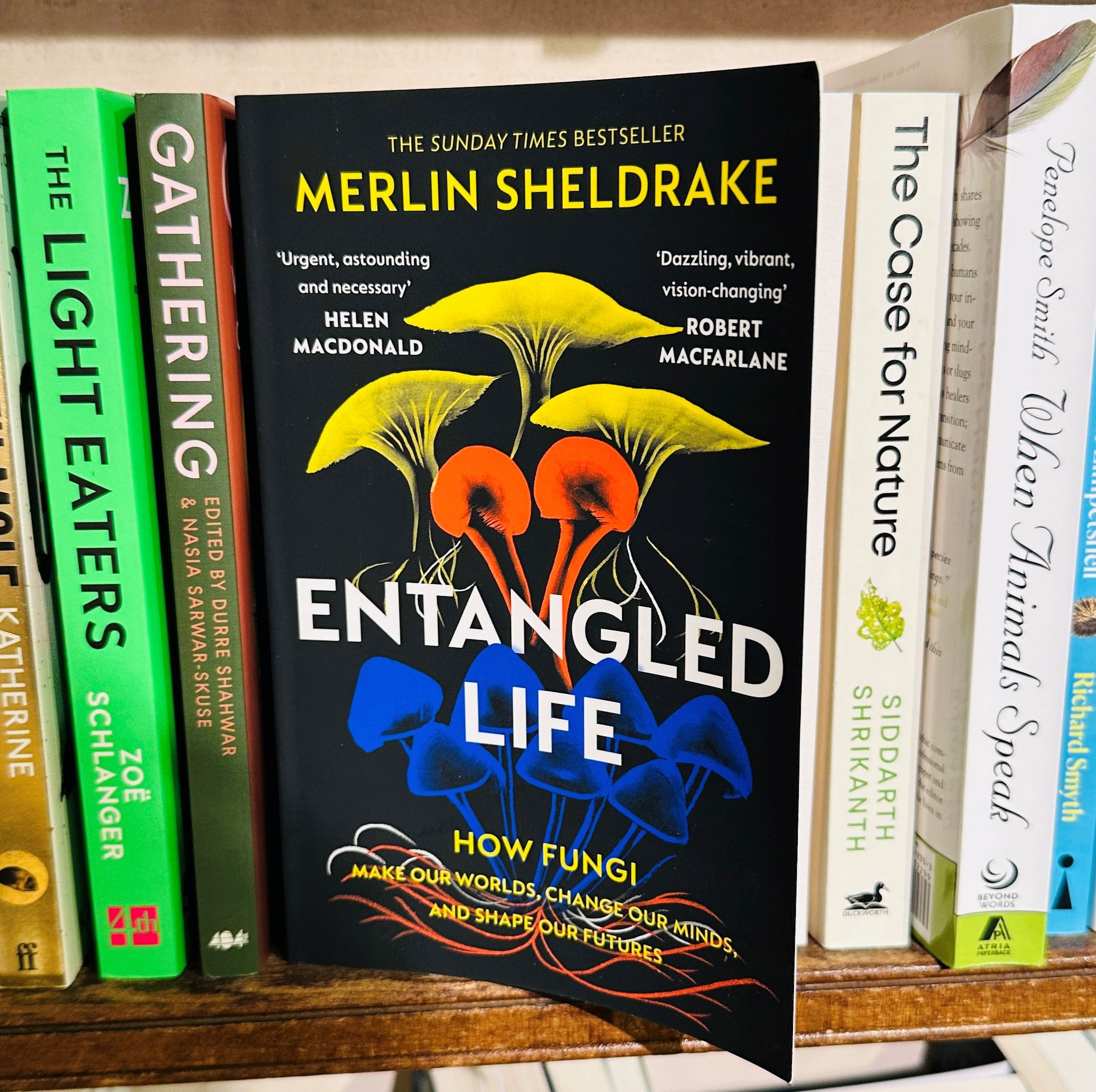
For the last couple of months, I have been reading a book called Entangled Life: How fungi make our worlds, change our minds & shape our futures by Merlin Sheldrake. I first encountered this book at a bookstore in London during my trip in January. The book cover, featuring illustrations of luminous fungi, caught my eye. Upon returning to Melbourne, I borrowed it from a library to take a deep dive into the stories about fungi.
Describing the book as eye-opening feels like an understatement – the scientific studies into the behaviours of various species of fungi made me think, ‘why aren’t we talking about these? Why don’t we learn about them in school, when the presence of fungi seems so crucial to the ecosystem?’ The world of fungi is not a focus of conversation even in the built environment industry, where we deal with ground conditions, existing landscapes, and various types of soil. In the field of architecture I work in, soil disturbance is considered, but there is almost no mention of the fungal network associated with existing vegetation. The only occasion I came across the relationship with fungi might be the new mycelium building materials in development.
Becoming more aware of fungi made me not only see the landscape differently, but also think more philosophically about the relationships between living creatures of various scales.
This article is a collection of thoughts on the fungi that I’m writing down here to come back to in the future.
Definition of an individual
Understandably, the inability to observe a creature’s presence (ie, invisible to human eyes) often leads to a lack of regard for it. While microbes (microscopic organisms) are everywhere, including on and in human bodies, the definition of a human tends not to recognise creatures that inhabit one. Sheldrake writes, “For your community of microbes – your ‘microbiome’ – your body is a plant… you carry around more microbes than your ‘own’ cells. There are more bacteria in your gut than stars in our galaxy”. In this case, is an individual human life actually composed of a multitude of microbial life that support crucial life processes (such as digestion)? Just like thinking about the potential population on distant planets that exist for every sun in the universe (each sun equating to a human) becomes slightly overwhelming, so does the thought of the universe (the world we live in) as a whole.
The idea that one life encompasses or accommodates another life shines a light on the ecosystem’s deeper, smaller scale. I love Sheldrake’s story about the attribution of a role within a plant (page 17), asking: is a particular chemical produced by the plant itself, by fungi living in the plant’s leaves, or by bacteria living in the fungi? The great unknown, in turn, poses a question about humans’ attempt to draw a line between ‘individual’ creatures, as we distinguish one human body from another. I began to think of microbes more like vibrating atoms, almost omnipresent and co-existing with/on/in other creatures, yet whose functions are often unrecognised.
A living network
This question about the definition of an individual takes on a different angle when it’s about a fungus with a mycelial ‘network’ but without any centre of control or typified bodies. Sheldrake writes, “control is dispersed: Mycelial coordination takes place both everywhere at once and nowhere in particular. A fragment of mycelium can regenerate an entire network, meaning that a single mycelial individual – if you’re brave enough to use that word – is potentially immortal.” (page 50) One of the experiments featured in the book, a study of the foraging behaviour of mycelium by Lynne Boddy, illustrates how a wood-rotting fungus radially spreads in search of a block of wood, but reorganises itself to become directional once it identifies the location of a fresh new block (page 46). It made me ponder how each hypha communicates information from its extensive search and responds to other signals from elsewhere, when there is no ‘brain’ to synthesise different information or coordinate movements. The image of countless fungi spreading, splitting, contracting, and consuming trees around the world feels surreal. The more I think about the network, the more I see opportunities to integrate mycelial networks into the broader discussion of ecosystems that architecture and landscape architecture address.
Another fascinating story in the book highlighted the mycorrhizal relationship between plants and fungi in the exchange of resources. The author’s encounter with the plant Voyria tenella leads to an exploration of how mycorrhizal relationships work between plants and fungi. Some plants pass carbohydrates to fungi, and fungi provide phosphorus (or other nutrients) to them reciprocally. In contrast, some plants, such as Voyria tenella, do not photosynthesise. Hence, they rely so much on fungi to pass on carbohydrates to survive. I was fascinated to learn that fungi control how much and to whom nutrients are delivered; their ability to understand each plant’s needs and to build trading relationships is something I never thought about.
Wood wide web – when the webs themselves are alive
The term ‘wood wide web’, coined by David Read in a commentary on Suzanne Simard’s Nature article, compares the fungal network to the internet in a humorous way. While Sheldrake notes the term is a ‘problematic metaphor’ for implying there is a single kind of network when there are numerous sorts of networks with various relationships within ecosystems (“ecosystems are riddled with webs of non-mycorrhizal fungal mycelium that stitch organisms into relation” (page 161)), I find the phrase useful in imagining how integral those mycelial networks are to both the specific individual plants and to the broader ecosystem, just like how internet has become integral to human lives. However, I agree with Sheldrake about the risk of a plant-centric view, in which fungi are seen as infrastructure for other plants to survive rather than living creatures with their own interests. ‘Fungal point of view’ is something I never quite thought about until I read this book, and I’m delighted to learn the presence of such webs.
Interacting with soil
The book made me reflect on the degree of superficiality in the mainstream understanding of ‘nature’ or ‘landscape, often due to the lack of discourse and limited significance given to their apparent impacts on humans’ economic activities. Imagine a project that involves environmental protection, not only because of the presence of significant trees and vegetation, but also because of significant mycelial networks that support the plants to thrive? Is there an alternative to having compacted soil, so that fungi can breathe and live in highly disturbed ground? Can the maintenance regime be designed to reduce manicuring work, protect fungi, and allow the local ecosystem to develop by itself?
The article on the ecologist Alison Pouliot made me think about how fungi broaden the perspective on the interconnected nature of creatures that collectively shape an ecosystem, and I would love this trail of conversation to become intertwined with the broader conversation around biodiversity.


