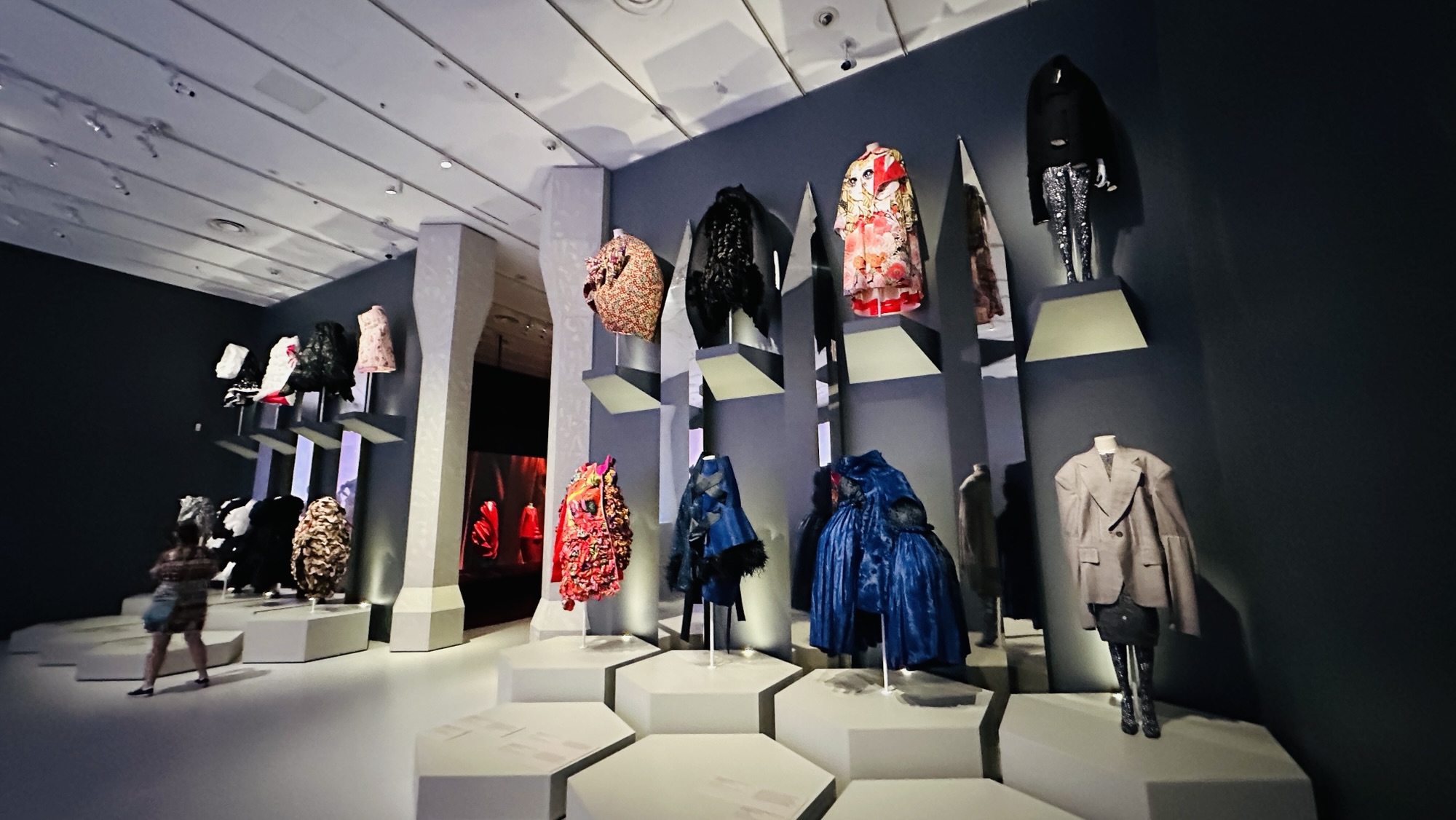
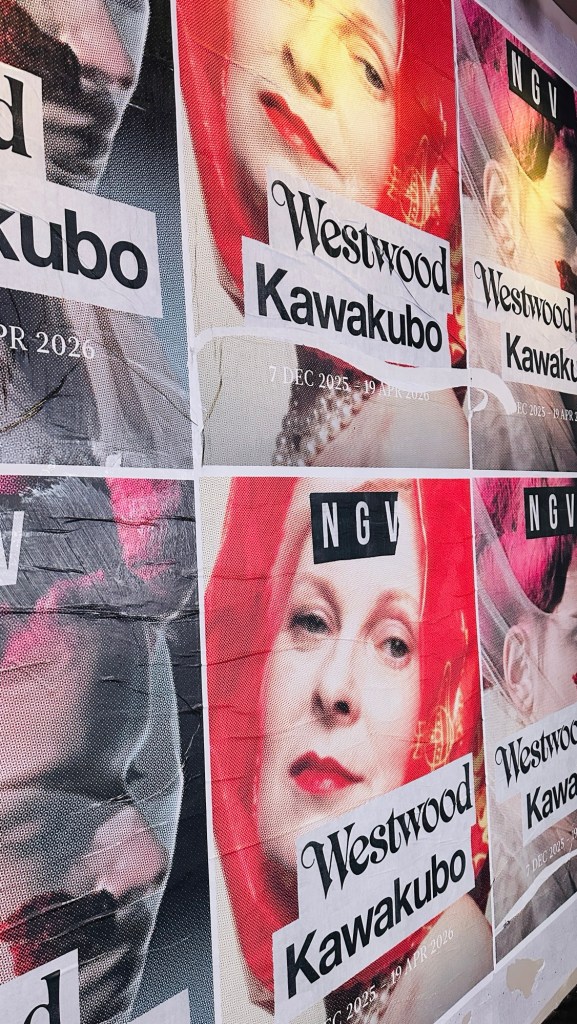
Westwood x Kawakubo, the major exhibition at the NGV International this summer, became a nice treat for me after another busy year. I visited the exhibition in late December, and it left me with some thoughts on the design approaches that attempt to be new and different.
The exhibition placed strong emphasis on situating two notable fashion designers within the cultural, social, and economic circumstances in which they lived. The extensive linear timeline of key moments in their lives and in society, wrapping around an ample exhibition space, highlighted the social norms around fashion and self-expression of the time that designers responded to. I loved a series of artefacts (such as an invitation flyer for their runway show) and media outlets featuring Westwood and Kawakubo, embedded in the timeline, that depicted how they portrayed their creative identities in mediums other than their garments. In particular, the video of a news reporter interviewing the public on how he was dressed (in clothes Westwood designed) suggested the distinction between the public perception of the punk culture and Westwood’s intent. While the interviewees’ responses are split in two (either finding punk fashion ‘weird’/‘stupid’, or ‘it suits [him] (but not for me)’), Westwood tells the reporter to wear what makes him feel confident and empowered. It is an excellent example of Westwood’s understanding of fashion as a means of self-expression rather than conformity with public discourse. Her belief, amid the rising popularity of punk rock, encouraged a rebellious spirit against social conformity, responding to the changing society in the 1970s.

The concept of rebellion against socially acceptable norms, in other words, introducing a new way of thinking or expressing oneself, is something we regard with great appreciation. While the exhibition recognises that both Westwood and Kawakubo bring new attitudes to fashion, it also contrasts their design approaches, which confront the idea of rebellion from opposing ends. It was fascinating to explore how they differ in their approach to the fashion of the past: while Westwood takes existing fashion vocabulary and reconfigures it into a new language (i.e., elements/techniques of tailoring), Kawakubo is creating an entirely new language using similar alphabets (i.e., materials). The displays of their garments made me think that Westwood is very much responding to the representation and social perception of fashion, but Kawakubo is responding to the broader definition of fashion. I loved Kawakubo’s rebuttal to critics that they’re missing the point when they questioned how wearable and practical her runway garments were.
Although I knew about Comme de Garçon and Kawakubo’s work, seeing them in person was such a mind-blowing experience. The play of geometries and proportion, enabled by the stable yet responsive internal structure, appears to fuse two contrasting ideas: one that negates the form of the human body, and the other that accentuates it through its relationship to the body. The three-dimensionality (and some intentional two-dimensionality) of her design appears straightforward until one observes closely to understand the complex cut-and-assembly techniques. The combination of the physical display of garments and the videos of runway shows highlighted the joy of Kawakubo’s design, both as static sculptures and as beautiful objects in motion.

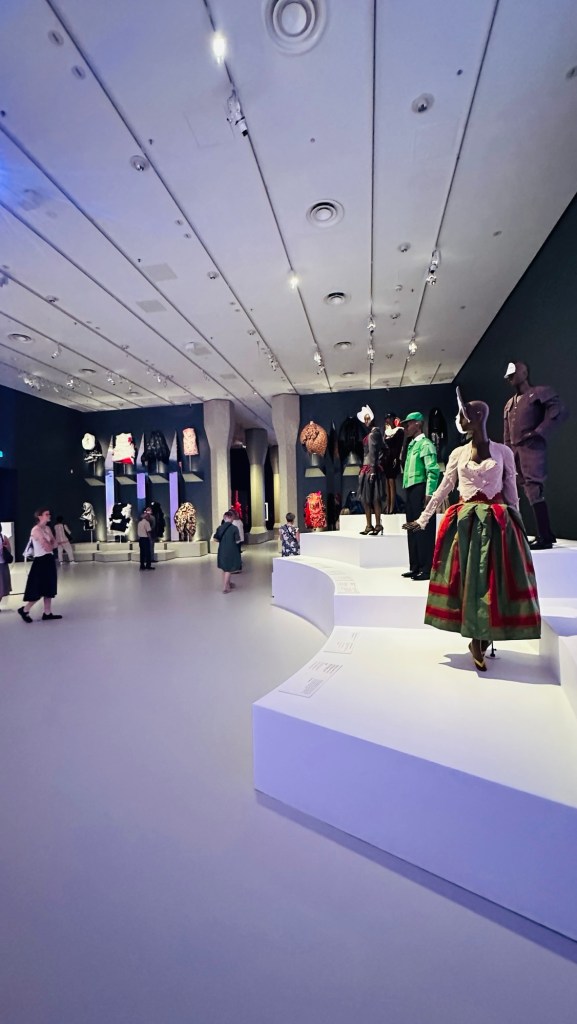
The exhibition with two notable fashion designers went above and beyond my expectations. The collections of works were phenomenal, and the curation and exhibition design brought out the similarities and differences between Westwood and Kawakubo in a spatial, compositional manner (symmetry across two sides, co-located, curved vs. linear layouts, etc.). Their garments made me ponder what it means to produce something ‘new’ in the world and how it can be achieved.

 Saran Kim | Blog