I had the pleasure of attending the inaugural Murcutt Symposium on 12th and 13th September at the State Library of NSW. The Symposium featured notable speakers, including Francis Kéré, Glenn Murcutt, Piers Taylor, Kerry and Lindsay Clare, Ché Wall, Rod Simpson, Carol Marra, and Catherine Hunter. This article is a collection of thoughts I gathered from listening to and pondering their practices and perspectives.
I thought about how to structure this article – and decided to try something different. Below are more of a series of bite-sized ideas and questions for our everyday work in the rigid system of the built industry, based on what those speakers mentioned.
Design follows needs – Kéré has been building schools so that his people can be educated—the necessity to build drives the architectural and construction processes. In the society of abundance, why do we build, and how can we build with purpose?
Prove it & bring people on board – Kéré talked about demonstrating to his people how a single-layered clay brick arch can be structurally stable, to convince them that his design works. How can we go a step further to prove to stakeholders and clients that your design works?
Process as knowledge transfer – Kéré described that a construction site becomes like a ‘market place’ where people spread materials on the ground and learn to work on building components. How can we better encourage builders/contractors to utilise a building process as a training ground?
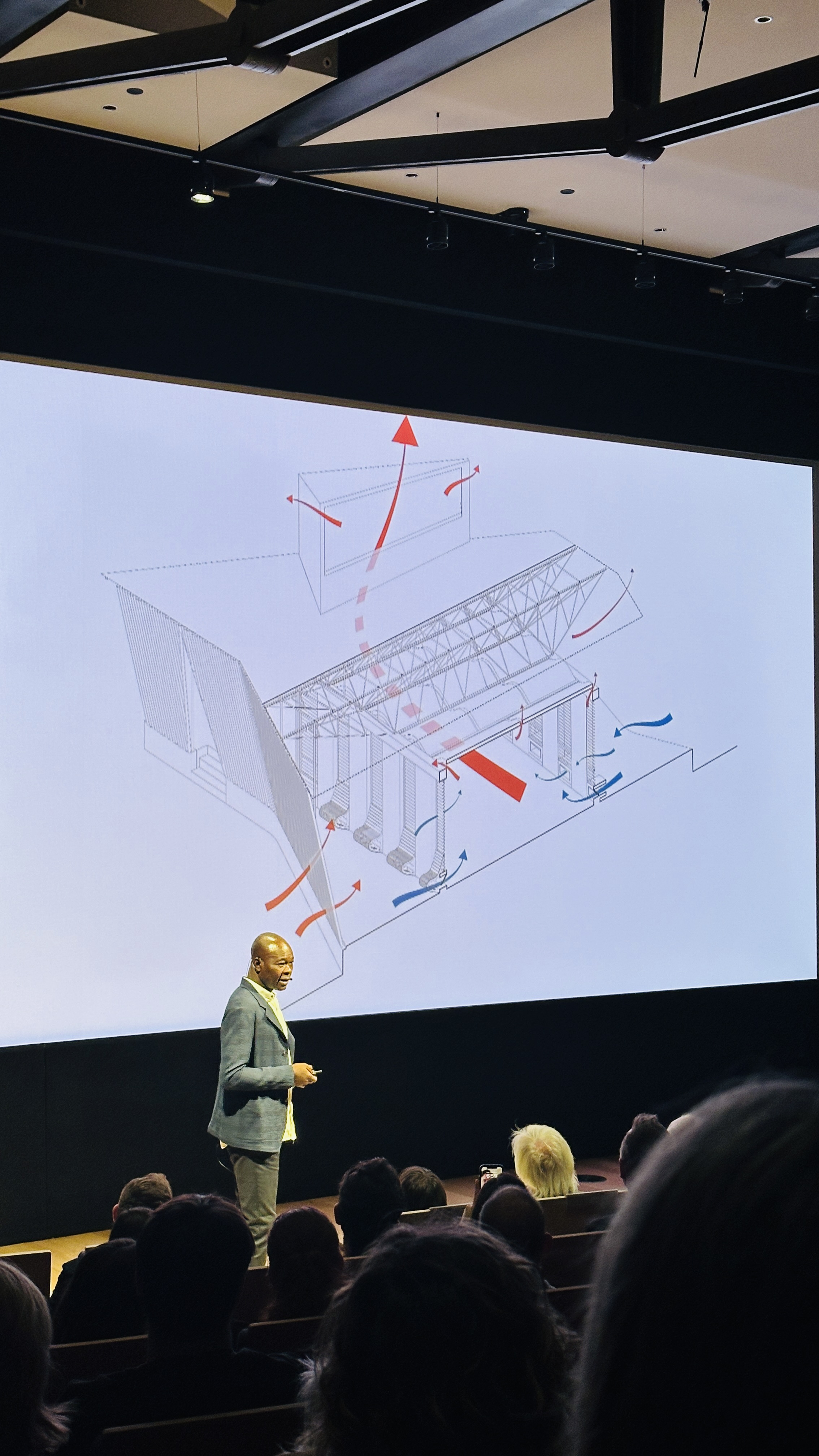
Perception of modernity – Kéré mentioned that his people initially thought of a ‘modern building’ being a concrete and steel building with full-height glazing, and were disappointed when Kéré said he would build with clay. How can we voice what the place needs and wants (ie, best suited to the climate), even when the client has a preconception of what they need?
Reinterpreting the capability of materials – Kéré knew the limitations of the use of readily available clay. His approach to improving the quality of clay (refining clay particles and creating bricks) changed how people perceive and understand materials around local people. How can we be better at utilising materials around us, and not rely on importing or sourcing materials from somewhere very far?
System of making building – Kéré talked about learning, absorbing and adapting architectural processes, and never mimicking something from one place to apply somewhere else. How can we design the architectural processes better to respond to specific places?
Simple and effective – one of my favourite moments was when Kéré showed the impact of planting trees using clay pots with a crack that fed water to seedlings over time. Such a simple idea using something available. How can we design simply for the maximum impact?
Intelligent client – Murcutt mentioned that a client who asks you to work on a building type you’ve never worked on is a clever and risk-taking client, compared to a client who wants you to replicate your past work. How can we attract clients who trust your ability to execute jobs well?
Perfection and imperfection – Murcutt noted the media tends to make architecture appear perfect, when architecture is never perfect. Is portraying/letting media portray architecture perfect in the best interest of the future of architecture, industry and profession?
Hesitation – Murcutt distinguished that while computers cannot ‘hesitate’, humans find answers through hesitation. If the ability to pause and contemplate ideas is essential for architecture, what are the implications of getting AI to design?
‘Working with community’ – this phrase didn’t sit well with Kéré, who clarified that ‘community work’ has never been the starting point of a project. It’s more than ‘working with the community’. How can we reframe our understanding of people involved in the project, not as individuals helping out the project, but as those who acquire a sense of ownership through it?

‘Making’ in context – Piers Taylor described the challenges between two types of ‘making’ processes: one at university in isolation, having ‘consultations’ and sourcing materials from afar, and one being hands-on with resourceful local people using local materials. How can the process of making create chances for people to meet and work together?
Definition of ‘healthy’ living – Ché Wall highlighted the risk of unbreathable houses (ie. excessive airtightness with uncontrolled ventilation) causing health implications. While the ability to control air movement by having an airtight building is critical, are we going way too far on the other end of the spectrum? Are we choking our houses made of climate and weather-responsive materials?
No bad weather – One of the speakers said, “there is no bad weather, just wrong clothes”. Can this idea be applied to buildings, so that we allow the building to adapt its enclosure better to specific seasons and weather conditions?
World’s best practice – Another quote. “World’s best practice is the locally specific one”. Why do we reference building systems from places where the climate is radically different? How can we better acknowledge the seasonal systems of the local areas and learn from traditional construction approaches?
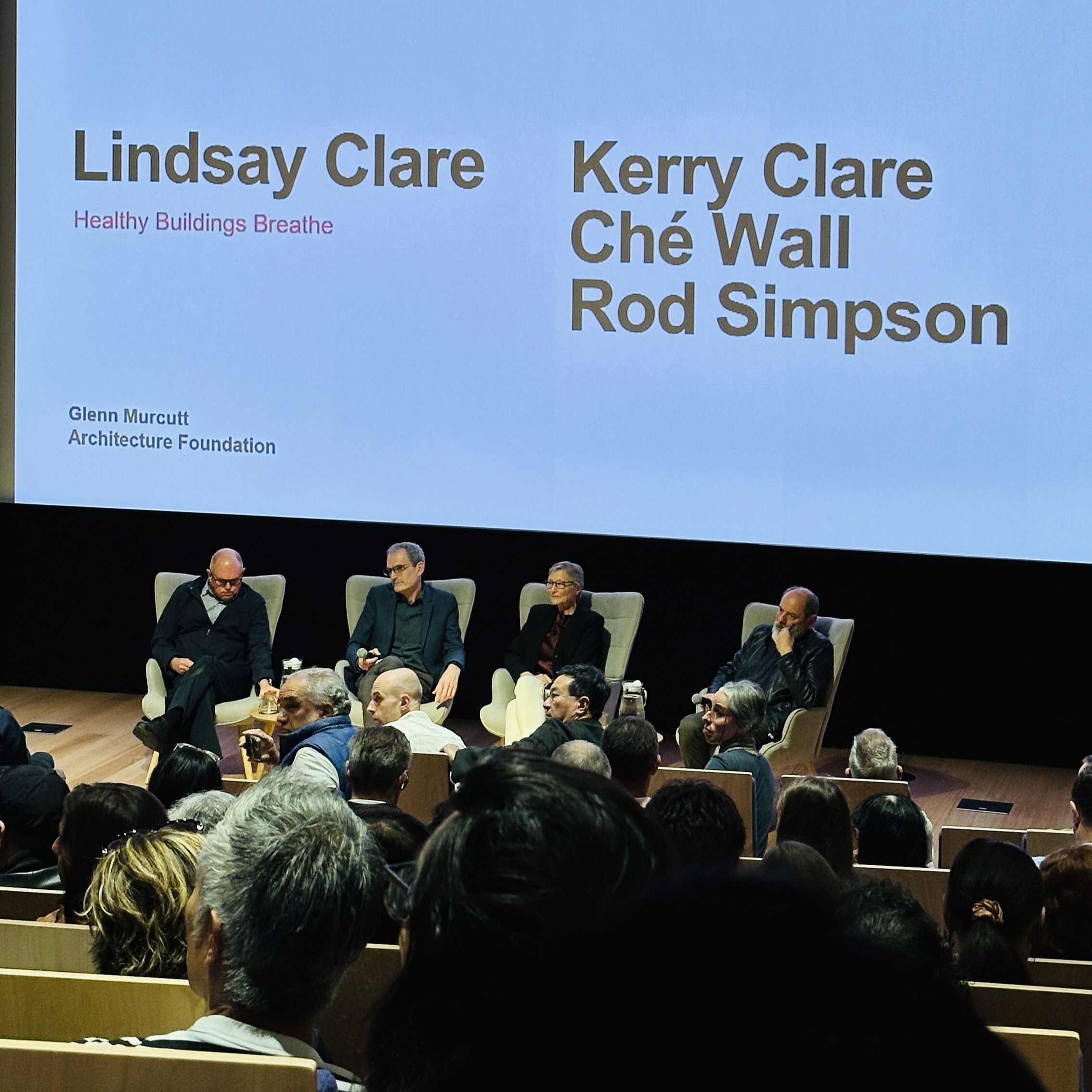
Working towards net-zero – Rod Simpson noted that building fabric itself doesn’t help enough to achieve net zero. The control over broader infrastructural shifts (e.g. electrification of the power grid) is out of architects’ expertise, but what can we do to support more systemic change?
Futureproofing – Carol Marra described the importance of integrating several futureproofing means and techniques to allow some aspects’ potential failure in climate resilience. What are our design’s plan B in future climate situations beyond our control?
Precedents by latitude – During the design process, Marra looked into vernacular/traditional architectural precedents in other countries based on latitude, where one can observe similar climatic features. How can we better learn lessons from traditional precedents in non-tokenistic ways?

Doing well – Murcutt said, it’s important to “do ordinary things very well”. Ordinary, everyday things don’t mean they are easy – when the industry seems to be more and more constrained and more levels of complexity are born, how can we stay grounded to the fundamentals of architecture and do them well?
It was indeed a packed program that generated a lot of thoughts for me. As always, meeting new people and seeing familiar faces was a great pleasure. Lastly, a big thanks to the wonderful John, who supported me in attending the symposium.


 Saran Kim | Blog