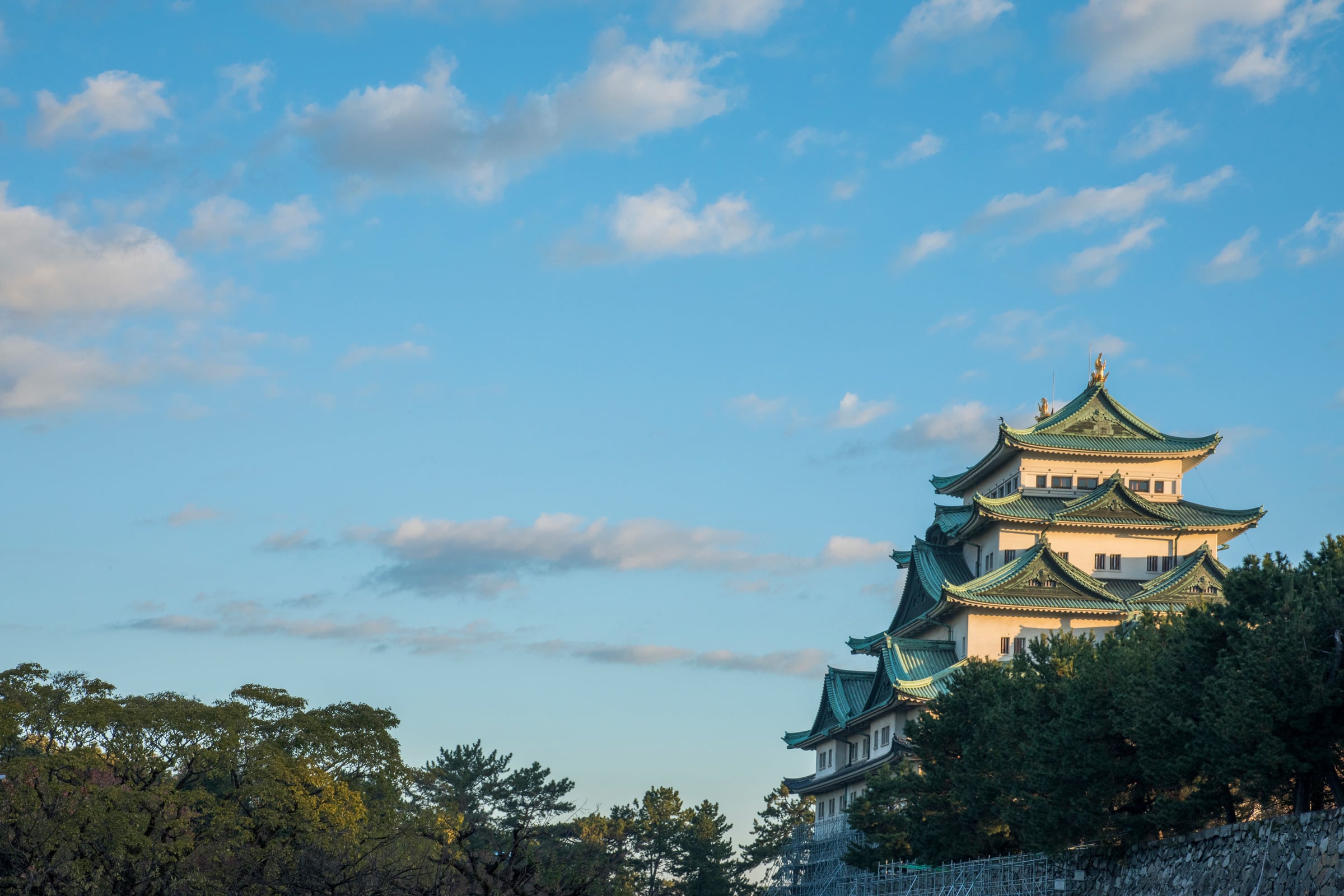
In October, a series of newspaper articles about the public controversy over the reconstruction of Nagoya Castle popped up on the Asahi Shinbun. The conflict between a group of people who support its ‘historically accurate’ restoration and the human rights advocacy groups baffled me, as the public discourse seems to dilute a complex web of feasibility challenges into the dichotomy of protecting (architectural) heritage and the need to accommodate those with accessible requirements. This longstanding, politicised public project caught my attention as a case of how the heritage buildings in Japan may be a source of architectural illusion, where ‘authenticity’ is intimately linked with romanticism over traditional forms of built fabric that seems to sweep all the other concerns under the rug.
The existing tenshu (castle tower) of Nagoya Castle consists of reinforced concrete constructed in 1959 after it was burnt down during World War II. As the structure has decayed over the last half a century, it poses the risk of collapse in future earthquakes. The mayor of Nagoya City has proposed the reconstruction of the tenshu with a ‘historically accurate’ traditional timber structure, design, materials and techniques, envisioning the tenshu to become a national treasure in the future that brings back local communities’ pride.
The central issue that ignited a severe public discussion is whether to provide a lift, which would prevent the tenshu from being built according to the historical drawings. The existing tenshu has a lift up to level 5; however, the proposal for the new tenshu only offers a tiny elevator (or considering how news articles don’t use the term elevator/lift, I imagine it’s a kind of stairlift or vertical platform) that goes up to level 1. In essence, the new tenshu between levels 1 and 5 won’t have equal access anymore.
As I read through several news articles on the project background, discriminatory words thrown at a person in a wheelchair at a public forum, and architectural implications, I couldn’t help but feel sad that people with disabilities have been put in a position to defend the need of lifts, when in fact it’s a consideration for everyone.
Approach toward Heritage
In her A.S. Hook Address, Kerstin Thompson described Spectrum of Change, “a dashboard that calibrates change of use relative to change of fabric“(30:36-), as an alternative to the binary thinking of the old and new when working with the buildings with heritage values. Her way of thinking helps untangle the messy and convoluted conversation around Nagoya Castle.
Firstly, Nagoya Castle was designed as a fortress, a defence mechanism intricate for enemies to enter and conquer. In the modern era, Japanese castles, including Nagoya Castle, have become historical and cultural sites with varying heritage conservation efforts. As its use has generally shifted to civic and cultural roles, the question is whether the castle should be conserved as an artefact built with historical accuracy or a place for the public to visit and interact. If the latter is the case, then the priority should be ensuring that the building is fit for occupation for people of all abilities (which does not mean it can be completely different from the historical drawings – but the design should serve the purpose). The use (or purpose) of the building helps clarify the aim of the reconstruction.
Secondly, the change of built fabric to accommodate the use of the castle as a cultural facility involves not only the accessible vertical circulation but also the new services, fire protection, emergency evacuation strategies and other aspects of the building standards compliance requirements that may not allow specific structural details from 400 years ago. Suppose the castle continues to be a tourist destination (where people enter and experience it). In that case, it is unclear why some compromises are acceptable, but accessibility concerns are not taken seriously.
What also complicates the situation is that the other castles in Japan recognised as national treasures or important cultural assets are not questioned for not having equal access (or even toilets). The cultural values of their built fabric, many of which were built in the Edo period, help the public recognise that priority is given to preserving the buildings over tourism, as the tangible elements tell the stories of the intangible values. It also raises a question about whether a newly reconstructed tenshu could ever achieve the same treatment as those national treasures or important cultural assets when its built fabric would not necessarily reflect the intangible heritage values of the time in which the castle was a castle – could it ever be more than a reconstruction? Would it be a physical relic without a lived purpose or memory?
Ultimately, the desire for historically accurate timber reconstruction derives from the abundance of historical references and drawings that enable it to happen, and what it used to be – the architectural fascination with the original beauty of Nagoya Castle tenshu. This case of Nagoya Castle revealed how the sense of authenticity could be obsessively attached to the historical accuracy of the built form and the title or label of its heritage value given by the government. Suppose the reconstruction of tenshu as a historical artefact is an answer. In that case, I hope Nagoya City clarifies the vision for the dream of architectural beauty and communicates it with the public for the greater good.
Cover image credit: Nagoya Castle

 Saran Kim | Blog